Joint efforts for the Baltic Sea: Conclusion of the EURENI project Baltic Coast Dialog
Copyright: Rewilding Oder Delta e.V.
How can the Baltic Sea be protected? The question was discussed by representatives from environmental associations, science and politics from countries bordering the Baltic Sea at the concluding conference of the EURENI project Baltic Coast Dialalog.
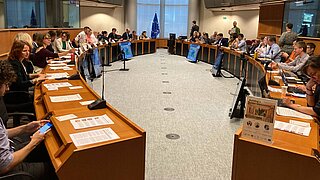
Some 80 participants met in Stralsund at the end of September to conclude the EURENI Baltic Coast Dialog project. They had spent two years exchanging views on the challenges and opportunities of the conservation of the Baltic Sea. Now they presented the suggestions and recommendations they developed for an effective conservation and restoration of the Baltic Sea’s ecosystem.
Cross-border dialogue for a sustainable Baltic Sea
The project is funded by the European Environment Initiative (EURENI) and supervised by Zukunft – Umwelt – Gesellschaft (ZUG) gGmbH for the Federal Ministry for the Environment, Climate Action, Nature Conservation and Nuclear Safety (BMUKN).
The objective of the project is to bring actors from various sectors together - including environmental organisations, authorities, fisheries, agriculture, tourism and science - from Germany, Lithuania, Poland and Sweden. They are to join forces to develop cross-border perspectives on conservation and restoration measures for the marine and coastal ecosystem of the Baltic Sea - in accordance with the EU Biodiversity Strategy for 2030 and the EU Nature Restoration Regulation.
Sebastian Unger, marine biologist and head of the “Marine Conservation” sub-division of the Federal Environment Ministry, pointed out in his keynote speech that the sea knows no borders. He emphasised the need for good exchange between the bordering countries, as the Baltic Sea can only be protected in the long term by means of intensive, cross-border dialogue.
From bottom trawling nets to ecosystem conservation
[Several topical workshops targeting central fields of action for the restoration and conservation of the Baltic Sea took place during the project.
Renaturation of marine and coastal ecosystems
One workshop focused on the integration of ecological principles into maritime planning and the utilisation of resources and presented practical examples from the Baltic Sea area. It became clear that marine and land use policies need to be more closely interlinked in order to effectively reduce the burdens on the Baltic Sea.
Management of fisheries in marine conservation areas
The effects and regulatory approaches to the use of bottom trawling nets were discussed. Professionals from the fishing industry and science as well as NGOs agreed that bottom trawling nets are a burden for sensitive habitats and that regulatory approaches need to be coordinated throughout the EU and adjusted on a regional basis.
Invasive species in the Baltic Sea
Experts showed that alien species not only present opportunities, but also risks. While mussels and crabs can influence local economic sectors, they also endanger existing ecosystems at the same time. They campaigned for more prevention and monitoring, as well as the joint consideration of ecological and economic aspects.
Digital platform for the Baltic Sea area
In addition to the topical workshops, the project established a digital exchange platform connecting actors stakeholders from all countries bordering the Baltic Sea: a LinkedIn Group especially launched for this purpose enables stakeholders to share their work, experiences and materials - an instrument that will continue to exist after the project is completed.
The project website also provides background information in five languages and makes the results of the discussions available to the general public.
The concluding conference showed that the Baltic Coast Dialog has set sustainable impulses by means of the direct exchange, practice-related recommendations for action and new networks. The participants agreed that work on the conservation of the Baltic Sea must be continued, even beyond the project duration.